Your HVAC system does far more than heat or cool your home.
It affects your comfort, indoor air quality, energy consumption, humidity, ventilation, operating costs, and the overall performance of your property.
And in Massachusetts, your HVAC system has to work through some of the most demanding seasonal conditions in the country.
Freezing winter temperatures.
Hot summer days.
Rapid temperature changes.
High humidity.
Snow and ice.
Coastal exposure.
Older homes with unique layouts.
Historic properties with limited mechanical space.
New construction with increasingly demanding energy requirements.
That is why HVAC installation and repair should be approached as a complete mechanical-system project—not simply the installation of a piece of equipment.
Brandon S. Broussard, Massachusetts-licensed HVAC contractor with BSB Mechanical & HVAC Inc., provides residential HVAC installation, replacement, maintenance, troubleshooting, and repair services throughout Suffolk County, Norfolk County, and surrounding Greater Boston communities.
Whether you need a new heating system, central air conditioning, a heat pump, ductwork, ventilation, a boiler, furnace, mini-split system, emergency repair, or a complete HVAC upgrade, BSB Mechanical & HVAC Inc. can help you evaluate the property and determine an appropriate solution.
A homeowner experiencing an HVAC problem may immediately think:
“My furnace is broken.”
Or:
“My air conditioner isn't working.”
But the equipment may not always be the real problem.
Poor airflow can be caused by ductwork.
Uneven temperatures can be caused by system sizing, distribution, insulation, air leakage, zoning, or building-envelope conditions.
High energy consumption can involve equipment efficiency, controls, duct losses, insulation, operating conditions, or the overall design of the system.
Poor indoor air quality can involve filtration, ventilation, humidity, combustion, ductwork, or inadequate outdoor-air exchange.
Repeated equipment failures can sometimes point to installation, sizing, airflow, drainage, electrical, refrigerant, combustion, or maintenance issues.
The objective should be to understand the system—not simply replace the component that happens to be failing.
A new HVAC installation should begin with the building.
The size of the home.
The layout.
The number of floors.
Insulation.
Windows.
Air leakage.
Orientation.
Occupancy.
Existing ductwork.
Available mechanical space.
Electrical service.
Fuel source.
Ventilation requirements.
The homeowner's comfort objectives.
And the applicable Massachusetts requirements.
The Massachusetts 10th Edition Building Code includes provisions governing mechanical systems, heating and cooling equipment, and related mechanical administration. Massachusetts also has building-energy requirements that can affect heating, cooling, and other mechanical-system decisions.
A properly planned HVAC installation therefore starts with understanding the property before selecting the equipment.
BSB Mechanical & HVAC Inc. can evaluate a broad range of residential HVAC projects, subject to project scope, licensing requirements, equipment specifications, applicable codes, permits, and manufacturer requirements.
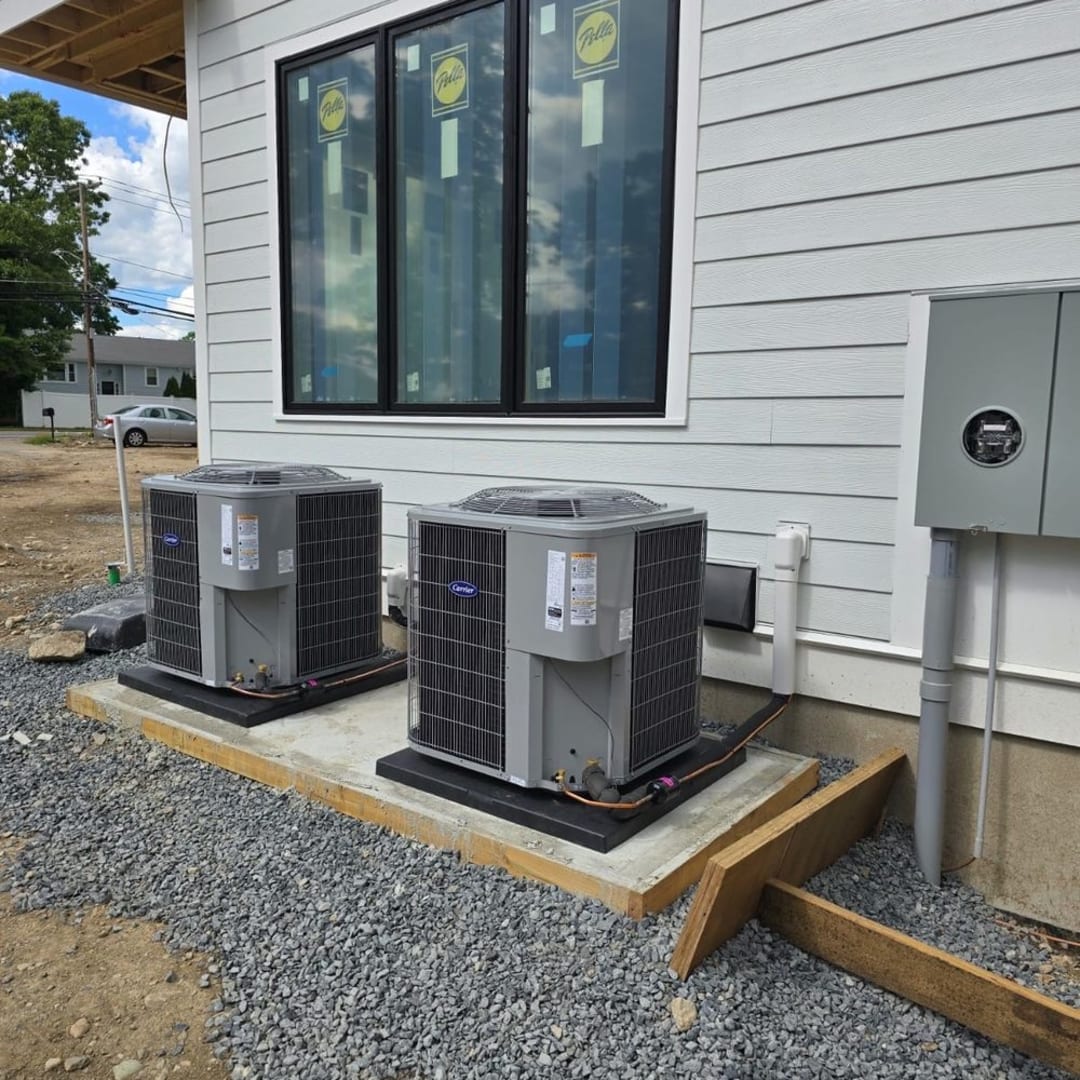
Central air-conditioning systems can provide whole-home cooling through a ducted distribution system.
Installation may include:
Outdoor condensing unit
Indoor evaporator coil
Air handler or furnace integration
Refrigerant lines
Condensate drainage
Supply ductwork
Return ductwork
Thermostat
Electrical connections
Controls
Equipment pad
System commissioning
Heat pumps can provide heating and cooling from one system.
Depending on the design, a heat pump may transfer heat into the home during cold weather and remove heat from the home during warm weather.
Heat-pump installations can include:
Air-source heat pumps
Ducted heat pumps
Ductless heat pumps
Mini-splits
Multi-zone systems
Central heat-pump systems
Cold-climate heat-pump applications
Heat-pump air handlers
Hybrid or dual-fuel configurations
The appropriate system depends on the property, electrical infrastructure, building envelope, design loads, climate considerations, equipment specifications, and applicable requirements.
Mini-split systems can be an excellent solution for properties where traditional ductwork is difficult or impractical.
They can be used for:
Older homes
Additions
Finished basements
Attics
Bedrooms
Home offices
Garages
Bonus rooms
Individual zones
Whole-home multi-zone systems
A ductless system can also provide a way to create independent temperature zones.
Multi-zone systems allow different areas of the home to receive individualized temperature control.
This can be especially useful for:
Multi-story homes
Larger homes
Homes with varying solar exposure
Additions
Bedrooms
Finished attics
Finished basements
Homes with different occupancy patterns
Furnaces can provide forced-air heating through a duct system.
Installation and replacement projects may involve:
Gas furnaces
Oil-fired furnaces
High-efficiency furnaces
Variable-speed equipment
Multi-stage equipment
Furnace and central-air combinations
Furnace and heat-pump configurations
The appropriate equipment depends on the property's requirements and applicable fuel, ventilation, combustion, efficiency, and code considerations.
Hydronic heating remains an important heating method throughout Massachusetts.
Boiler projects may include:
Hot-water boilers
Steam boilers
Gas boilers
Oil-fired boilers
High-efficiency boilers
Condensing boilers
Boiler replacements
Hydronic heating upgrades
Hydronic systems use heated water to distribute heat throughout a property.
Applications can include:
Baseboard heating
Radiators
Radiant-floor heating
In-floor heating
Hydronic zones
Boiler-based heating systems
Radiant heating can provide heat through floors rather than relying exclusively on forced-air distribution.
Applications may include:
New construction
Bathroom floors
Kitchen floors
Basement renovations
Additions
Whole-home systems
Air handlers can be used with heat pumps and other HVAC configurations to distribute conditioned air throughout the home.
Ductwork is a critical component of a forced-air HVAC system.
BSB Mechanical & HVAC Inc. can address:
Supply ducts
Return ducts
Main trunks
Branch ducts
Registers
Grilles
Dampers
Transitions
Duct insulation
Duct sealing
Airflow distribution
Existing ductwork may not always be appropriate for a new HVAC system.
Duct modifications can be necessary when:
Adding an addition
Finishing a basement
Renovating an attic
Installing a larger or different system
Creating new zones
Correcting airflow problems
Reconfiguring a home
Modern HVAC systems can incorporate sophisticated controls.
Services may include:
Standard thermostats
Programmable thermostats
Smart thermostats
Wi-Fi controls
Multi-zone controls
Remote temperature monitoring
Equipment controls
Zoning controls
Zoning allows different portions of a home to be controlled independently.
A properly designed zoning system may use:
Motorized dampers
Multiple thermostats
Zone controllers
Separate duct zones
Dedicated equipment
Heating and cooling are only part of indoor environmental quality.
Ventilation systems can help provide controlled outdoor-air exchange.
Depending on the property, systems may include:
Exhaust ventilation
Supply ventilation
Balanced ventilation
Energy recovery ventilation
Heat recovery ventilation
Whole-home ventilation
Bathroom exhaust
Kitchen exhaust
Dedicated ventilation systems
Energy Recovery Ventilators and Heat Recovery Ventilators can provide controlled ventilation while recovering energy from outgoing air.
These systems can be particularly relevant to tightly constructed homes and energy-conscious renovation and new-construction projects.
Massachusetts summers can create uncomfortable humidity levels.
Dedicated dehumidification can be used where standard air conditioning does not adequately address humidity requirements.
Applications may include:
Basements
Finished lower levels
Whole-home systems
High-humidity homes
Homes with specific indoor-air-quality objectives
Winter heating can reduce indoor humidity.
Humidification systems can help homeowners manage excessively dry indoor conditions.
Finished basements often have unique heating, cooling, humidity, and ventilation requirements.
BSB Mechanical & HVAC Inc. can evaluate HVAC solutions for:
Finished basements
Basement apartments
Recreation rooms
Home theaters
Home offices
Guest spaces
Attic conversions and finished attic spaces often require specialized HVAC planning.
Possible solutions include:
Ductless mini-splits
Dedicated zones
Ducted systems
Heat pumps
Ventilation
Humidity management
When you add square footage to your home, the existing HVAC system may not automatically have sufficient capacity.
Additions may require:
Additional zones
Ductwork modifications
New equipment
Mini-splits
Heat pumps
Extended hydronic systems
New thermostats
New ventilation
For a new home, HVAC planning should begin early.
The mechanical system should coordinate with:
Building envelope
Insulation
Windows
Electrical service
Plumbing
Structural design
Interior layout
Energy requirements
Ventilation
Equipment locations
This allows the HVAC system to be integrated into the home instead of being treated as an afterthought.
Older Massachusetts homes can present unique HVAC challenges.
Historic properties may have:
Limited mechanical space
Existing radiators
Steam systems
Thick masonry
Multiple additions
Unusual layouts
Older ductwork
Limited chases
Preservation considerations
The best HVAC solution may therefore involve modernization without unnecessarily compromising the character of the property.
HVAC systems for duplexes, triplexes, townhouses, and other multifamily properties can involve additional considerations involving:
Multiple units
Individual controls
Separate zones
Common mechanical spaces
Ventilation
Equipment sizing
Energy requirements
Distribution
Access and serviceability
Depending on licensing, project scope, equipment, and applicable requirements, HVAC services may also extend to qualifying commercial or mixed-use applications.
Commercial mechanical projects can involve substantially different requirements from single-family residential work and should be evaluated individually.
An HVAC failure can happen at the worst possible time.
A furnace stops working during a Massachusetts winter night.
An air conditioner stops cooling during a July heat wave.
A boiler begins leaking.
A heat pump starts short-cycling.
A mini-split begins producing an error code.
One room becomes dramatically hotter or colder than the rest of the home.
The goal of a professional HVAC repair is not simply to make the equipment start running again.
The goal is to identify the problem and determine the appropriate repair.
Potential furnace issues can include:
Failure to ignite
Ignition problems
Blower problems
Limit-switch issues
Thermostat problems
Electrical problems
Airflow restrictions
Combustion issues
Control-board problems
Short cycling
Insufficient heat
Unusual noises
Boiler repairs may involve:
No heat
Leaks
Pressure problems
Circulator issues
Expansion-tank problems
Thermostat issues
Zone-valve problems
Burner problems
Ignition issues
Air in the system
Uneven heating
Temperature-control problems
Air-conditioning repairs can involve:
System not cooling
Weak airflow
Electrical failures
Frozen coils
Condensate problems
Refrigerant-related issues
Thermostat problems
Compressor problems
Condenser problems
Fan problems
Drainage issues
Heat-pump troubleshooting can involve:
Insufficient heating
Insufficient cooling
Defrost problems
Outdoor-unit issues
Indoor-unit problems
Airflow problems
Control problems
Electrical problems
Refrigerant-related issues
Thermostat problems
Short cycling
Mini-split systems can experience:
Error codes
Poor cooling
Poor heating
Water leakage
Frozen coils
Fan problems
Communication errors
Drainage problems
Remote-control issues
Outdoor-unit failures
Ductwork problems can contribute to:
Poor airflow
Uneven temperatures
Excessive noise
Energy loss
Dust infiltration
Pressure problems
Rooms that never reach the desired temperature
Repairs may include sealing, insulating, reconnecting, modifying, or replacing duct sections.
Thermostat problems can prevent otherwise functional HVAC equipment from operating correctly.
Airflow problems can result from:
Dirty filters
Blocked ducts
Damaged ductwork
Improper duct sizing
Blower problems
Closed dampers
Equipment restrictions
Poor system design
Cooling and heat-pump systems use refrigerant circuits that require appropriate diagnosis, equipment, procedures, and licensing.
Possible issues include:
Refrigerant leaks
Pressure problems
Coil problems
Refrigerant-flow issues
Compressor problems
Expansion-device problems
A system should not simply be repeatedly “topped off” without investigating the underlying issue.
Air conditioners, heat pumps, and other equipment can generate condensate.
Problems can include:
Clogged drains
Overflowing condensate pans
Drain-line blockages
Pump failures
Water leaks
Moisture damage
HVAC equipment relies on electrical components and controls.
Troubleshooting can involve:
Capacitors
Contactors
Relays
Control boards
Motors
Wiring
Sensors
Thermostats
Safety controls
Electrical work must be performed within the applicable licensing and regulatory requirements.
Blower problems can create inadequate airflow, unusual noises, overheating, or complete system failure.
Compressors are a major component of air-conditioning and heat-pump systems.
Compressor issues require careful diagnosis because replacement may need to be evaluated against the age, condition, refrigerant system, and overall economics of the equipment.
Indoor and outdoor fan motors can fail because of mechanical wear, electrical problems, bearings, controls, or other conditions.
Gas-fired heating equipment can experience ignition and flame-sensing issues that prevent proper operation.
These systems require appropriate diagnostic and safety procedures.
If your HVAC system repeatedly starts and stops, the problem should be investigated.
Potential contributing factors can include:
Equipment sizing
Thermostat problems
Airflow restrictions
Refrigeration issues
Control problems
Overheating
Other mechanical conditions
When your heating system stops producing heat, BSB Mechanical & HVAC Inc. can diagnose the system and identify potential causes.
When your air conditioner or heat pump stops cooling, diagnosis can determine whether the problem involves airflow, electrical components, controls, refrigeration, equipment failure, or another condition.
If one room is freezing while another is too warm, replacing the HVAC equipment may not automatically solve the problem.
The cause may involve:
Ductwork
Airflow
Zoning
Insulation
Windows
Building-envelope conditions
Equipment sizing
Thermostat location
System balancing
HVAC failures can create urgent situations, particularly during Massachusetts heating season.
Emergency service may involve stabilizing the system, identifying the immediate failure, and determining whether a repair or replacement is appropriate.
One of the most important HVAC decisions is determining whether continued repairs make sense.
A repair may be appropriate when:
The equipment is otherwise in good condition
The problem is isolated
The repair is reasonable
The system has useful remaining life
Replacement isn't necessary
Replacement may deserve consideration when:
The system is aging
Major components have failed
Repairs are becoming frequent
Operating costs are excessive
Parts are difficult to obtain
The system is poorly matched to the home
The home has undergone major renovations
The equipment is inefficient
The homeowner wants to transition to a different heating/cooling technology
The cheapest repair today isn't always the least expensive decision over the next several years.
Likewise, replacement isn't automatically the answer to every repair.
The objective is to evaluate the system and make an informed decision.
Massachusetts HVAC systems have to perform through dramatically different seasons.
Winter demands reliable heating.
Summer demands dependable cooling.
Spring and fall can require frequent system transitions.
Humidity can affect comfort.
Older homes can present unusual mechanical challenges.
Newer homes can require sophisticated ventilation and energy-performance strategies.
Massachusetts' current 10th Edition building code incorporates Massachusetts-specific amendments to the 2021 International Codes, including mechanical and energy-related requirements.
Massachusetts also has multiple energy-code pathways. The Base Code applies statewide as the baseline, while municipalities can adopt Stretch or Specialized Code requirements. The state's current municipal adoption map identifies communities that have adopted different energy-code levels.
That local difference matters.
An HVAC project in Boston may not have exactly the same energy-code considerations as a project in another Massachusetts municipality.
That is why BSB Mechanical & HVAC Inc. approaches each project based on the actual property and location.
BSB Mechanical & HVAC Inc. provides HVAC installation, replacement, repair, and mechanical-system services throughout Suffolk County, including:
From historic brownstones and traditional homes to new construction, condominiums, multifamily properties, additions, and major renovations, Boston properties can present unique HVAC challenges.
BSB Mechanical & HVAC Inc. can help evaluate heating, cooling, ventilation, zoning, equipment replacement, and system modernization.
Chelsea properties can include older housing stock, multifamily properties, renovations, additions, and newer construction.
HVAC solutions may range from equipment replacement and repairs to ductless systems, heat pumps, and larger mechanical projects.
Revere homeowners can face coastal exposure, older construction, additions, renovations, and changing comfort requirements.
HVAC systems should be evaluated with the individual property's design and conditions in mind.
Winthrop's coastal environment and diverse housing stock can create unique considerations for HVAC equipment, ventilation, humidity, and overall building performance.
BSB Mechanical & HVAC Inc. also serves homeowners and property owners throughout Norfolk County, including:
Heating and cooling replacements, heat pumps, ductless systems, central air, boilers, furnaces, repairs, and larger residential HVAC projects.
Historic homes, renovations, additions, multifamily properties, and higher-end residential projects can require thoughtful mechanical planning.
HVAC replacements, repairs, heat pumps, central air, furnaces, boilers, ductwork, zoning, and residential mechanical projects.
Traditional homes, renovations, additions, heating replacements, cooling installations, and complete HVAC upgrades.
Custom homes, historic properties, additions, renovations, heat pumps, central HVAC systems, and higher-end residential mechanical projects.
Larger homes, renovations, additions, new construction, HVAC replacements, zoning, heat pumps, and sophisticated mechanical systems.
Residential HVAC installation, replacement, repair, ductwork, heating, cooling, and ventilation.
HVAC repairs, system replacements, heating and cooling installation, ductless systems, and residential mechanical work.
Residential HVAC installation, repair, replacement, heat pumps, central air, boilers, furnaces, ventilation, and renovation-related HVAC work.
There are plenty of companies that can sell you an HVAC system.
The better question is:
Who is going to help you determine what system actually makes sense for your property?
That's where BSB Mechanical & HVAC Inc. is designed to stand apart.
Brandon S. Broussard brings Massachusetts HVAC contracting experience to residential mechanical projects throughout Greater Boston.
The goal is to approach the project professionally and within applicable Massachusetts requirements.
The objective isn't simply:
“Install a new furnace.”
It's:
“Determine what heating system is appropriate for this property.”
That distinction matters.
An HVAC system doesn't operate independently from the house.
It interacts with:
Walls
Windows
Insulation
Roof
Attic
Basement
Ductwork
Electrical system
Building envelope
Ventilation
Interior layout
Understanding construction can help create a more complete mechanical strategy.
Brandon's broader professional experience in real estate, mortgage, insurance, construction, and HVAC gives him a property-oriented perspective.
That can be particularly valuable when an HVAC project is connected to:
Buying a home
Selling a home
Renovating a home
Building an addition
Finishing a basement
Converting an attic
Constructing a new home
Improving energy performance
Managing an investment property
The businesses remain separate legal entities, but the broader professional perspective can help identify how a mechanical project fits into the larger property.
If you're building a home or completing a major renovation, HVAC planning should happen early.
For example:
A new addition may require additional heating and cooling capacity, ductwork, zoning, or a separate system.
A finished attic may require a dedicated mini-split, ducted system, or another solution depending on the design.
A basement may require heating, cooling, dehumidification, ventilation, or dedicated zoning.
A major addition may require an entirely new HVAC strategy.
A renovation can be the perfect opportunity to evaluate whether the existing HVAC system still makes sense.
The HVAC system can be planned alongside the building envelope, insulation, windows, electrical system, ventilation, and energy requirements.
We begin by understanding your property, your comfort concerns, your project goals, and your existing HVAC system.
The existing equipment, distribution, controls, accessible ductwork, mechanical space, and other relevant components are evaluated.
For repairs, the objective is to identify the likely cause rather than simply treat the symptom.
Depending on the situation, options may include:
Repair
Replace a component
Modify the system
Improve ductwork
Add zoning
Install supplemental equipment
Replace the entire system
Transition to a different HVAC technology
The appropriate system should consider:
Property size
Building characteristics
Heating load
Cooling load
Existing distribution
Electrical capacity
Fuel availability
Homeowner preferences
Budget
Energy requirements
Long-term objectives
Applicable code requirements
The project is completed according to the agreed scope, applicable requirements, and manufacturer specifications.
Equipment and controls are checked as appropriate to the project so the system can be placed into service.
The homeowner receives an opportunity to understand the completed work, system operation, controls, and maintenance considerations.
A properly installed HVAC system still requires maintenance.
Depending on the system, maintenance can involve:
Filter replacement
Equipment inspection
Coil inspection
Condensate-drain inspection
Electrical-component inspection
Blower inspection
Refrigeration-system evaluation
Combustion-system inspection
Thermostat evaluation
Ductwork inspection
Airflow evaluation
System cleaning
General performance checks
Maintenance requirements vary by equipment type and manufacturer.
The goal is to identify developing issues before they become major failures whenever reasonably possible.
Contact BSB Mechanical & HVAC Inc. if you are experiencing:
No heat
No air conditioning
Uneven temperatures
Weak airflow
Strange noises
Strange odors
Water around HVAC equipment
Repeated system shutdowns
Short cycling
High energy usage
Poor humidity control
Poor indoor comfort
Thermostat problems
Furnace problems
Boiler problems
Heat-pump problems
Central-air problems
Mini-split problems
Ductwork problems
Ventilation problems
An aging HVAC system
A planned renovation
A new addition
A finished basement
A finished attic
A new construction project
The best time to think about HVAC replacement is often before the system fails on the coldest night of the year or the hottest day of summer.
If your system is aging, requiring frequent repairs, struggling to maintain temperature, or no longer appropriate for the home, a proactive evaluation can give you more time to understand your options.
Not the other way around.
Whether you need a simple repair, complete HVAC replacement, new construction mechanical systems, heat-pump installation, ductless mini-splits, central air, a boiler, furnace, ventilation, zoning, or a comprehensive HVAC upgrade, BSB Mechanical & HVAC Inc. can help you evaluate the project from a broader construction perspective.
Brandon S. Broussard
Massachusetts-Licensed HVAC Contractor
BSB Mechanical & HVAC Inc.
Serving homeowners and property owners throughout Suffolk County and Norfolk County, Massachusetts, including Boston, Chelsea, Revere, Winthrop, Quincy, Brookline, Braintree, Dedham, Milton, Needham, Norwood, Randolph, Weymouth, and surrounding Greater Boston communities.
Whether you're dealing with an HVAC emergency, planning a system replacement, building an addition, renovating your home, or constructing a new property, start with a professional evaluation.
Contact BSB Mechanical & HVAC Inc. today to discuss your HVAC installation, replacement, repair, or renovation project.
HVAC projects are subject to applicable Massachusetts laws, regulations, building codes, mechanical requirements, energy codes, permit requirements, manufacturer specifications, municipal requirements, existing property conditions, and contractual terms.
Massachusetts' 10th Edition Building Code is currently in effect. Massachusetts municipalities can also have different applicable energy-code requirements, including Base, Stretch, and Specialized Code requirements.
The appropriate HVAC system, equipment, installation method, repairs, permits, inspections, engineering, electrical work, plumbing work, refrigeration work, gas work, ventilation, and other specialty services will depend on the specific project. Additional licensed professionals or specialty contractors may be required depending on the scope.
Equipment performance, energy savings, operating costs, comfort improvements, and future repair requirements are not guaranteed and depend on the equipment, installation, building characteristics, operating conditions, maintenance, utility rates, weather, and other factors.
No statement on this page constitutes a guarantee of energy savings, reduced utility bills, equipment lifespan, indoor-air-quality improvement, comfort level, project cost, or return on investment.
Final recommendations, equipment selections, project scope, pricing, warranties, and responsibilities should be established through the applicable written proposal or contract.
BSB Mechanical & HVAC Inc. is a separate legal entity from any real estate, mortgage, insurance, construction, or other professional businesses with which Brandon S. Broussard may be affiliated or licensed. Services are subject to applicable licensing, regulatory, contractual, and professional requirements.
Greater New England Area
Here to help with all your construction and HVAC needs.
Sign in with your email address
Enter your email address
Please wait...
You’re being redirected to the page with listing data.